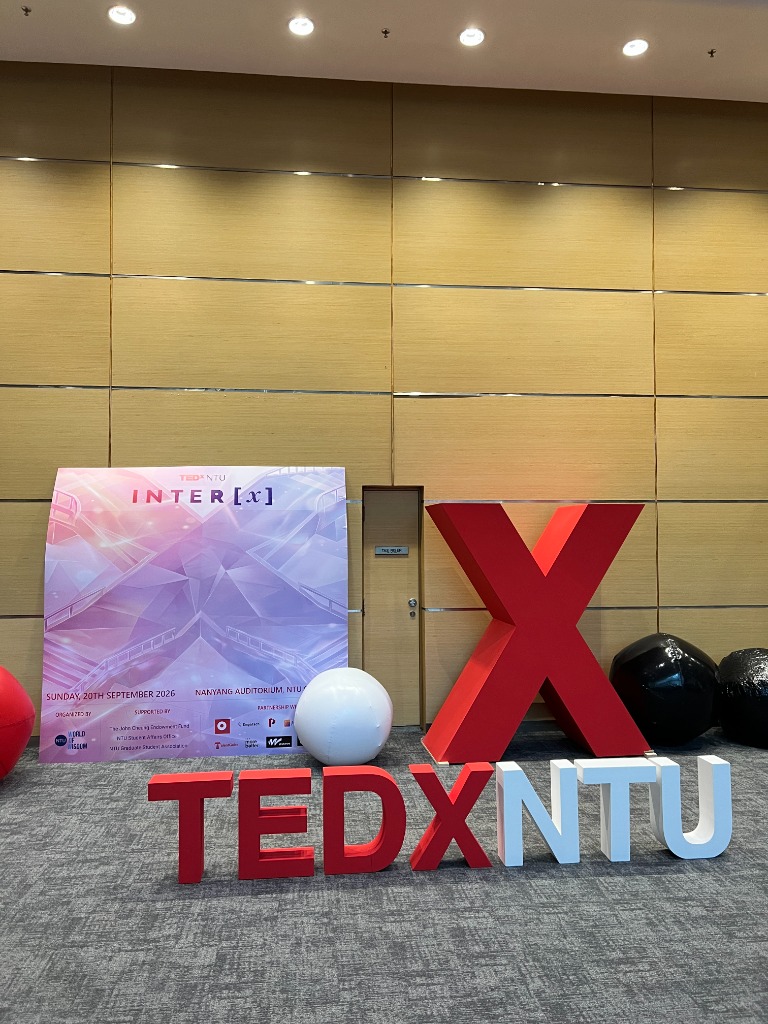
20 September 2026 · Nanyang Auditorium, NTU Singapore
TEDxNTU 2026
Inter[X].
What becomes possible when different disciplines meet? Exploring how ideas cross boundaries at Nanyang Auditorium—from bat immunology and acoustic storytelling to theatre and empathy. A reflection on learning across disciplines as a biomedical science student.
![Hosts and speakers on stage introducing TEDxNTU Inter[X] at Nanyang Auditorium.](/_next/image?url=%2Fimages%2Fcontent%2Ftedxntu%2Ftedxntu-stage-emcees.jpg&w=1920&q=75)
Filling in
the unknown "X".
The organizers left the "X" for each of us to fill in: interact, intersect, interrupt. Sitting in the auditorium, I thought of interdisciplinary, international, and even intergenerational.
As someone studying both Biomedical Sciences and BioBusiness, I often find myself thinking about where fields overlap and where new value is born. Being in the room for TEDxNTU gave that question concrete faces and stories.
Throughout the day, speakers demonstrated how much richer our understanding becomes when we stop viewing knowledge in rigid silos:
Unpacking decision-making, bias, and leadership dynamics through neural circuitry.
Looking past raw transaction metrics to explore ritual, culture, and communal belonging.
Using stagecraft and emotional presence to practise the hardest bedside conversations.
Studying mammalian longevity and viral tolerance to invent therapeutics for humans.
As an undergraduate still exploring which areas to deepen, it was genuinely exhilarating to see the potency of working across disciplines. Real-world challenges rarely conform to university department divisions. They require people who are willing to bridge vocabularies, ask naive questions with genuine curiosity, and translate insights from one realm into another.
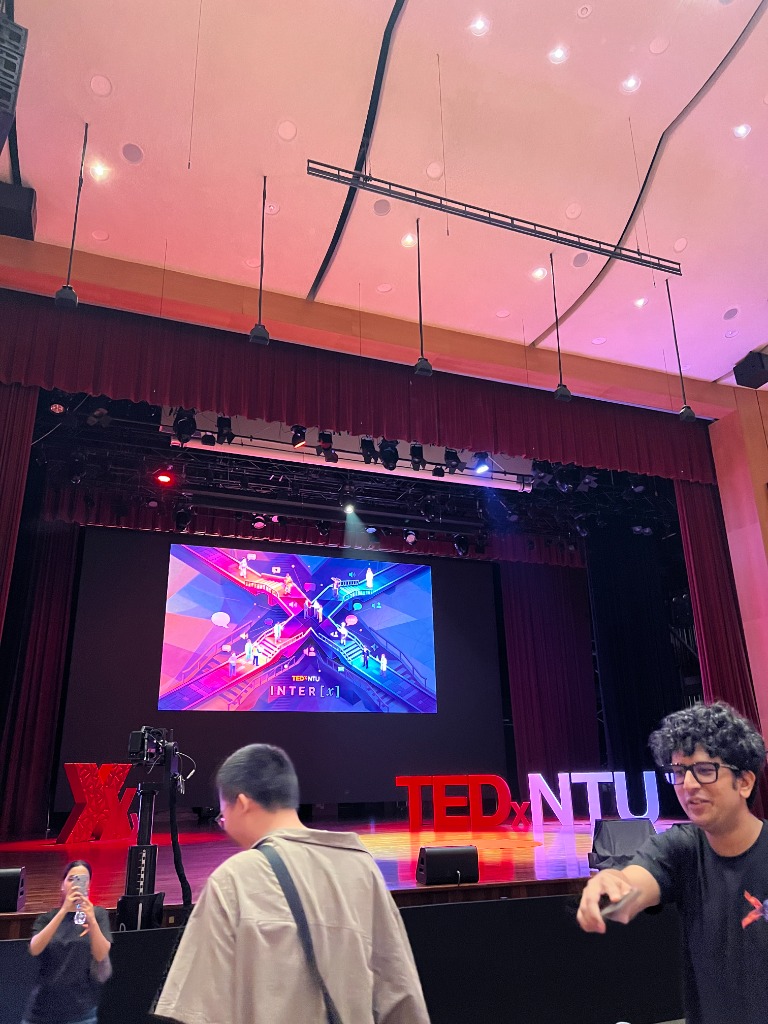
From the dynamic lighting of the stage to the energy of attendees filling the hall, the event embodied what happens when ideas collide.
![Vertical view of Nanyang Auditorium stage showing illuminated INTER [x] crossroads graphic and TEDxNTU sign.](/_next/image?url=%2Fimages%2Fcontent%2Ftedxntu%2Ftedxntu-stage-inter-x.jpg&w=1200&q=75)
Are bats friend or foe?
Prof Linfa Wang (Duke-NUS).
The talk that intrigued me most was by Prof Linfa Wang of Duke-NUS Medical School, affectionately known throughout the global scientific community as the "Batman of Academia."
In roughly 25 years, bat-linked viruses have caused six major global viral outbreaks—from the Hendra virus in 1994, to Nipah, Marburg, SARS, and the COVID-19 pandemic we all lived through. Prof Wang has been on the frontlines investigating every single one.
He started his career as what he called a "bat-virus man," tracing where emerging pathogens originate. But over time, his work turned in an unexpected direction: toward the bats themselves. For Prof Wang, the definitive answer to whether bats are friend or foe is friend.
The Bat Advantage: Tight Immune Regulation
Bats have co-evolved with deadly viruses for millions of years. They host these pathogens while remaining largely unharmed, unlike other mammals. Why? Because their bodies tightly suppress and balance inflammation, preventing destructive hyper-immune overreactions while still keeping viral replication in check.
The Human Vulnerability: Hyper-Inflammation
In humans, severe respiratory and viral distress is often not caused solely by the virus itself, but by our own immune system going into overdrive—a lethal "cytokine storm." The very immune response intended to protect us ends up inflicting catastrophic tissue damage.
Prof Wang’s laboratory at Duke-NUS discovered a specific gene mechanism that allows bats to keep this inflammatory response so finely balanced—a mechanism that no longer functions in human physiology. In preclinical studies, laboratory mice provided with this bat-derived mechanism survived viral exposures that proved lethal to normal mice. Today, a novel therapeutic drug directly inspired by bats is advancing toward human clinical trials.
A Biomedical Student’s Reflection
As a biomedical science student, I found this way of conceptualising disease deeply striking. It reframes pathology from simple pathogen destruction to host response moderation.
And that principle holds far beyond research: sometimes it isn't the challenge you face that hurts you, but how you respond to it.
Sounds contain
stories.
Prof Marcus Tan did something unexpected in a high-energy auditorium: he had hundreds of us close our eyes and simply listen.
In that collective silence, he guided us to perceive how much of a place, a culture, and a memory lives inside its acoustic texture. A bustling hawker centre, the rustle of tropical leaves, the distinct hum of an MRT station—sounds are not mere passive background noise. As Prof Tan stated: "Sounds contain stories."
As a clarinettist with the NTU Symphony Orchestra and a drummer, this resonated deeply with me. Music has taught me that listening requires active patience. We live in an overwhelmingly visual and text-driven culture; tuning our ears back to timbre, resonance, and tempo reveals nuances about people and places that our eyes easily glaze over.
"Close your eyes and simply listen. Sounds contain stories, holding the memory and heartbeat of a place."
— Prof Marcus Tan, TEDxNTU 2026
From watching a circumstance
to standing inside it.
The closing talk on acting and empathy by Ms Tysha Khan touched me most. It reminded me why art and humanity are not decorative electives, but essential compasses for life.
Ms Khan shared words passed down from her acting-school director that remained with me long after leaving the auditorium:
"Art cannot change the world, but art can change people, and people can change the world."
— Words shared by Ms Tysha Khan, Actor & Theatre-maker
She then challenged the audience to reconsider how we engage with one another: how much might our world shift if we all took the deliberate time to stand in each other's shoes?
"From the outside in to the inside out. From watching a circumstance to standing inside it."
In a university environment and a fast-moving city that frequently feels like a relentless rat race—measured in grades, milestones, and resume lines—art has always been a significant, grounding part of my life. Whether playing in the orchestra or listening quietly, I will keep making room for it.
For me, Tysha’s words speak directly to what learning across disciplines asks of every one of us: not merely accumulating facts, but cultivating a genuine willingness to step into another perspective and let it change our own.
What learning across
disciplines really asks of us.
Bridging science, business, and humanity is not an abstract exercise—it is a daily practice of humility and curiosity.
Biomedical Rigour
ScienceLooking closely at molecular mechanics, viral biology, and the balance of immune systems to understand how living organisms maintain resilience.
Attentive Listening
AcousticsPausing sensory overload to truly hear soundscapes, discovering that communities and places carry their deepest histories in what they sound like.
Empathy & Perspective
TheatreStepping into another person's shoes—moving from watching a circumstance from the outside to standing inside it from the inside out.
Moments from
Nanyang Auditorium.
Visual fragments from an unforgettable day of ideas, community, and cross-disciplinary exploration.