Web Development
Digital InterfaceBuilding a clear, accessible website to communicate the purpose and vision of the initiative, ensuring healthcare partners and visitors could easily explore the project's background.
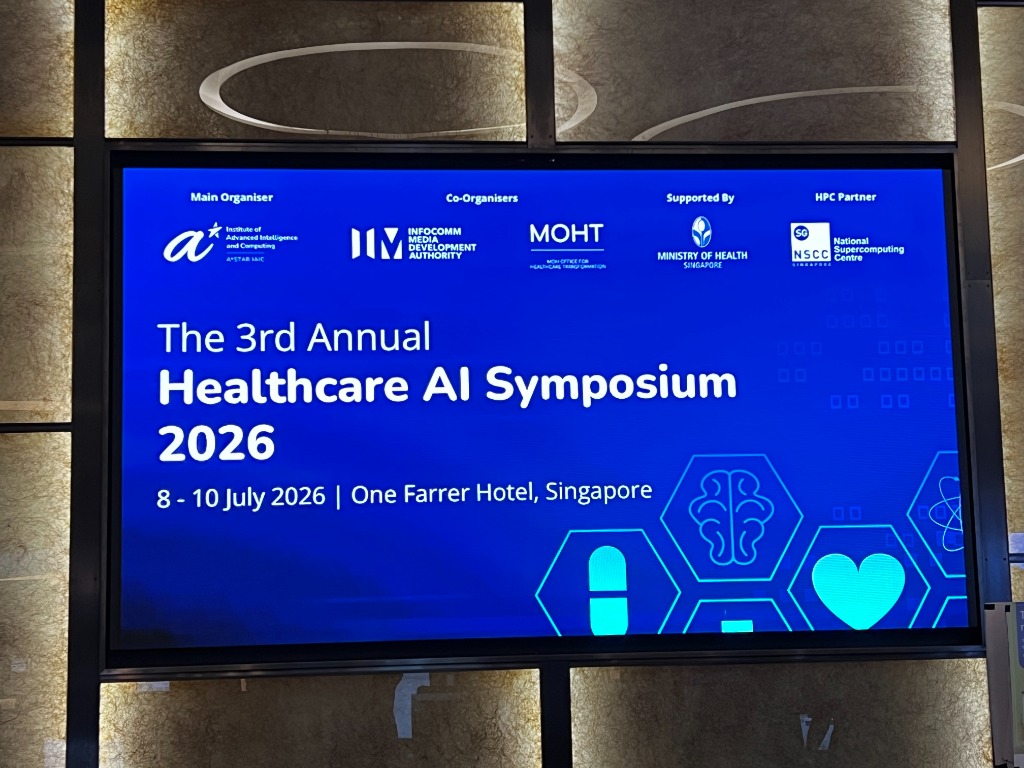
8–10 July 2026 · One Farrer Hotel, Singapore
Reflections from representing Face AI across three days at The 3rd Annual Healthcare AI Symposium. From assisting at the exhibition booth to an inspiring moment alongside Senior Minister of State Tan Kiat How—experiencing how communication, design, and usability help bring scientific innovation closer to the healthcare community.

Bringing research institutions, health clusters, and national agencies into one hall at One Farrer Hotel.
From 8 to 10 July 2026, the Grand Ballroom at One Farrer Hotel hosted The 3rd Annual Healthcare AI Symposium 2026. Organized by the A*STAR Institute of Advanced Intelligence and Computing, together with co-organizers IMDA (Infocomm Media Development Authority) and MOHT (MOH Office for Healthcare Transformation), supported by the Ministry of Health Singapore and supercomputing partner NSCC, the symposium stood as Singapore’s premier forum examining how computational intelligence transforms clinical practice and preventive care.
Being in that space as an undergraduate student studying Biomedical Sciences and BioBusiness on the NTU–Duke-NUS Pathways to Medicine was an eye-opening privilege. Rather than discussing AI as an abstract benchmark, conversations across the three days centered on clinical safety, workflow adoption, and how screening tools can meaningfully reach people before disease escalates.

A project is only as impactful as its ability to be understood, adopted, and trusted by the humans who interact with it.
I want to be completely clear: I did not develop the machine or screening device in itself, nor did I build the underlying AI technology or diagnostic models. That hardware engineering, sensor integration, and computational research belongs entirely to the dedicated research scientists, engineers, and clinical collaborators across A*STAR and healthcare institutions.
I joined Face AI through NTU's veNTUre programme as a student intern. My contribution was centered on communication, design, and user-facing materials: developing the website, creating 3D visual design assets, designing the instructional book manual, and helping out on-site at the symposium booth.
My responsibilities focused on the visual, instructional, and digital communication aspects of the project:
Building a clear, accessible website to communicate the purpose and vision of the initiative, ensuring healthcare partners and visitors could easily explore the project's background.
Creating 3D digital renderings and visual assets to help illustrate the screening workflow and concept in presentation materials—distinct from the physical engineering of the machine itself.
Crafting visual documentation that translates procedural steps into intuitive, straightforward guidance, making it easier for staff and community operators to follow the workflow.
Representing Face AI on the symposium floor across three days: helping staff the booth, answering questions about the user experience, and observing how healthcare professionals and clinicians interact with new screening initiatives.
A moment of encouragement that highlighted Singapore’s shared commitment to nurturing homegrown healthcare and technological talent.
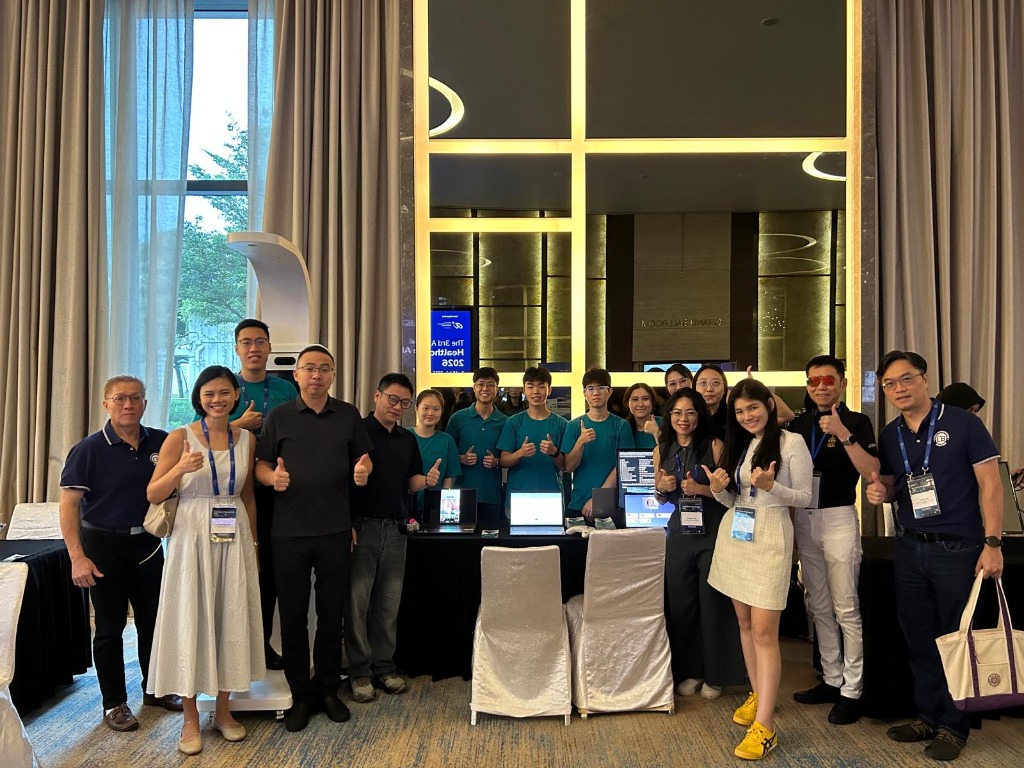
A major highlight of the symposium was welcoming Senior Minister of State Tan Kiat How (Senior Minister of State for Digital Development and Information, and National Development) to our exhibition area.
Having national leaders take the time to visit project booths, listen to student contributors and research teams, and engage directly with local health-tech initiatives was deeply encouraging. As a student intern assisting at the booth who had contributed to the website, 3D visual assets, and instructional manual, seeing the entire team—from senior investigators and healthcare partners to fellow student contributors—gather together for a shared photograph was an unforgettable feeling of collective pride.
The group photo captured that exact spirit: thumbs up all around, gathered together at the demonstration booth alongside laptops, project displays, and symposium attendees. Standing in the center of that team photo beside SMS Tan Kiat How and our collaborators reminded me that meaningful health innovation is always a team sport.
“Standing beside senior ministers and leading scientists wasn't just about a photo. It was a reminder that even as a student, every thoughtful design choice, manual page, and conversation at the booth helps bridge the gap between science and people.”
— Reflection on representing Face AI, July 2026
How this experience crystallized what I want to dedicate my future studies and clinical aspirations toward.
Working with Face AI and being present at the Healthcare AI Symposium clarified something fundamental about how I see my future path in medicine:
Everything must start with rigorous evidence, biological validity, and clinical responsibility. Without robust science, technological novelty is hollow.
Great inventions fail if they cannot survive real-world operational realities, regulatory paths, and sustainable deployment models. Understanding biobusiness is crucial.
The ultimate benchmark is always human. Does a patient feel comfortable? Can an elderly visitor understand the instructions? Technology must serve with empathy.
That convergence—Science × Business × Technology for Human Care—is where I want to continue learning and growing.
Archival photographs from The 3rd Annual Healthcare AI Symposium 2026 at One Farrer Hotel, Singapore.