August 2026 · NTU Making and Tinkering (PS5888) · Group 22
Making & Tinkering:
DreamCatcher.
An autonomous quadcopter wake-up and docking system created to eliminate morning snoozing. When the alarm activates, the drone launches and hovers in the room—requiring you to physically stand up, retrieve the aircraft, return it to the docking station, and prove to an infrared bed-monitoring camera that you haven’t immediately returned to sleep.
The Product
In Action.
Watch our prototype demonstrate the complete morning wake-up cycle: scheduled autonomous takeoff, optical-flow hovering, alarm feedback, physical docking verification, and sleep-monitoring validation.
Product Showcase: DreamCatcher in action — demonstrating the scheduled alarm takeoff, stable hover, physical docking authentication, and active bed-monitoring workflow.
🔇 Audio Muted by DefaultRedesigning the
Wake-Up Interaction.
Existing alarms assume that pressing a button equals waking up. Behavioral science proves that assumption is wrong.
Our Core Design Question
“How do we redesign the wake-up interaction so that dismissing an alarm naturally requires physical activity and evidence that the user has not immediately returned to sleep?”
Waking up in the morning is a universal struggle. We reach out blindly, hit snooze, and slip back into fragmented sleep. Research reveals the extent of this habit:
| Wake-Up Approach | Requires Physical Movement? | Prevents Passive Dismissal? | Verifies Continued Wakefulness? |
|---|---|---|---|
| Phone across room | Yes | Partly (can carry phone to bed) | No |
| Puzzle alarm apps (Alarmy) | No (solved lying down) | Partly | No (invites doomscrolling) |
| Moving alarm clocks (Clocky) | Yes | Yes | No (can catch & return to bed) |
| Multiple sequential alarms | No | No (becomes background noise) | No |
| DreamCatcher (Group 22) | Yes (Retrieve hovering drone) | Yes (RFID dock disarm) | Yes (NoIR camera bed tracking) |
The Multi-Stage
Operational Workflow.
DreamCatcher coordinates a synchronized pipeline between a web interface, a Raspberry Pi central hub, a custom quadcopter, and computer-vision bed tracking.
Signal Dispatch & Takeoff
When the scheduled alarm time is reached, the server transmits takeoff telemetry across local Wi-Fi. The quadcopter arms and automatically ascends into a stable hover inside the bedroom.
Optical Flow Hover & Audio-Visual Stimulus
The drone maintains indoor position hold using its downward MicoAir MTF-02P optical flow sensor without requiring GPS. Simultaneously, dock speakers sound high-volume alarms and relay-driven disco lights flash.
User Retrieval & Physical Disruption
To silence the airborne noise, the user is compelled to get out of bed, walk across the room, safely catch the protected drone, and carry it back to the dock—shattering sleep inertia through bodily movement.
RFID Dock Authentication
Placing the aircraft on the 22×22 cm PLA dock triggers an embedded RC522 RFID reader. Once the drone's unique tag is authenticated, the motors disarm and the primary siren shuts off.
NoIR Infrared Bed-Occupancy Monitoring
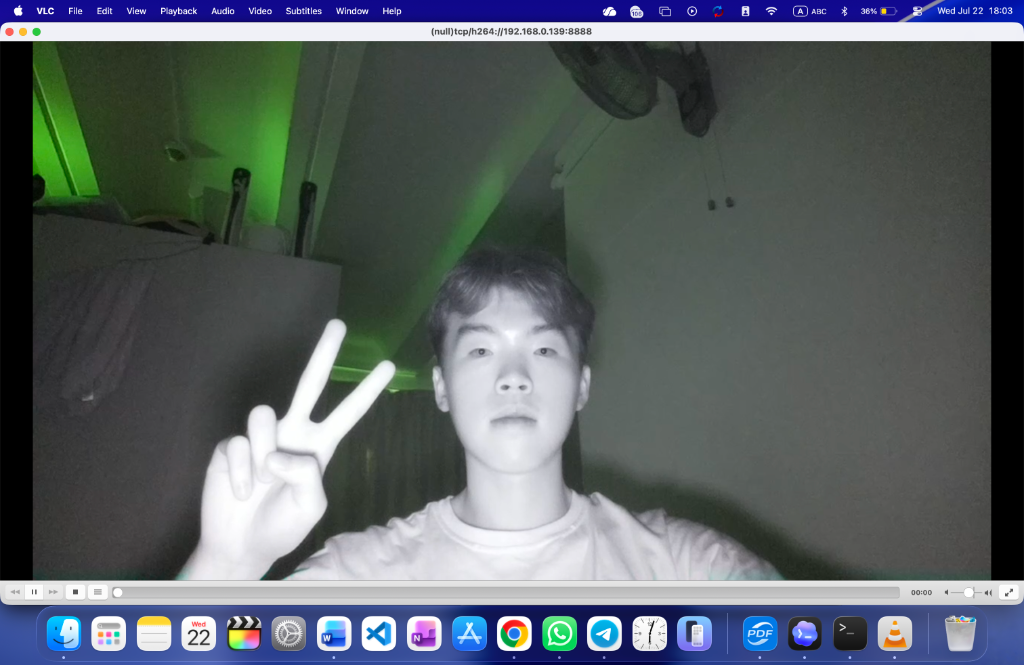
Silencing the alarm starts a monitoring grace period. An ESP32 NoIR camera with a 940 nm non-visible IR emitter scans the bed area in pitch darkness to verify whether the user remains upright and out of bed.
Anti-Cheat Re-Trigger
If pose or motion detection senses the user climbing back under the blankets before the wakefulness window ends, the system immediately sounds the alarm again, ensuring long-term morning adherence.
Bench Testing &
Hardware Exploration.
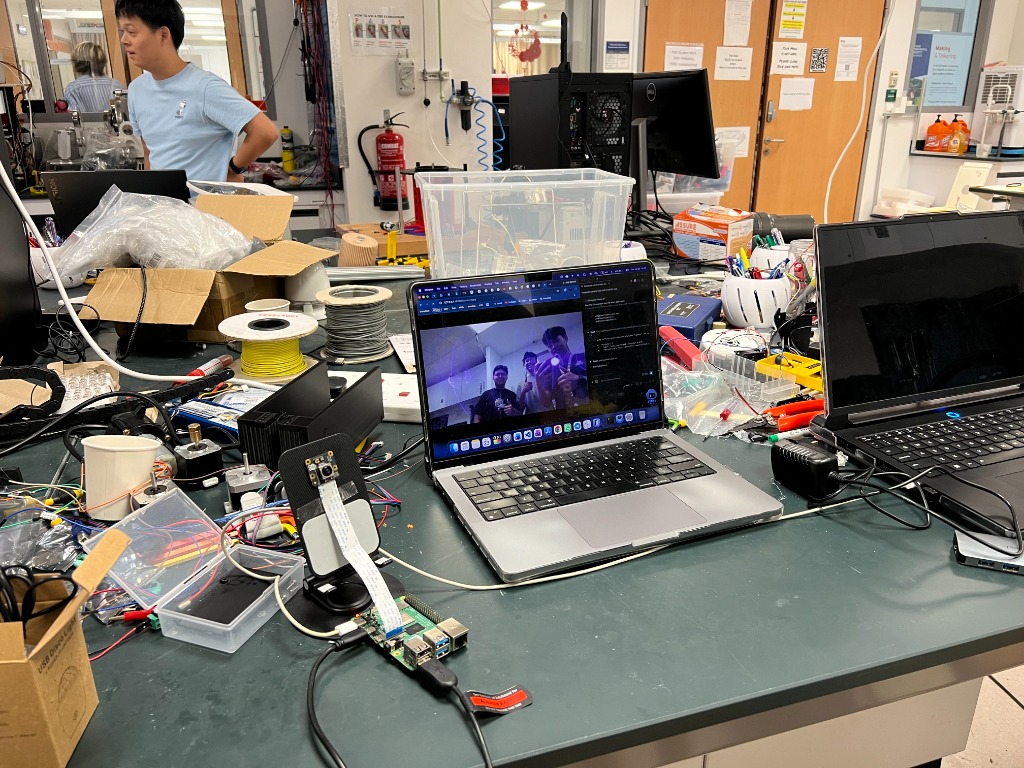
Photographs from our weeks of prototyping, soldering, calibrating sensors, and testing live computer vision in the lab.
Materials, Electronics &
Design Decisions.
Transforming an ambitious idea into a functioning indoor prototype required deliberate trade-offs across weight, structural safety, sensor choice, and power.
| Subsystem | Component & Specification |
|---|---|
| Dock Footprint | 22 × 22 cm landing platform with custom alignment guide |
| Chassis Material | 3D-printed PLA with reinforced wall orientation and baseboard feet |
| Central Controller | Raspberry Pi coordinating Wi-Fi telemetry, web daemon, and scheduler |
| Vision & Bed Tracking | ESP32 NoIR Camera Module paired with MediaPipe / YOLO pose tracking |
| Night-Vision Emitter | Dual 940 nm non-visible infrared LEDs (zero red glow disturbance) |
| Dock Verification | RC522 13.56 MHz RFID reader beneath the landing pad surface |
| Indoor Navigation | Downward MicoAir MTF-02P optical flow & rangefinding module (GPS-denied) |
| Audio-Visual Alarm | Dual high-decibel dock speakers & 5V relay-switched disco light module |
| Communication Protocol | Local Wi-Fi link with MicoAir wireless telemetry module |
Engineering Reality & Constraints: Engineering in the real world is about understanding physical limitations. Every extra sensor added to the drone increased mass, demanding larger motors and a heavier LiPo battery—reducing flight endurance. Our downward optical-flow sensor provided steady altitude hold above textured carpets and tiles, but remained sensitive to smooth or reflective surfaces. Furthermore, relying on LiPo battery cells necessitated careful balance-charging and strict safety protocols during indoor tests.
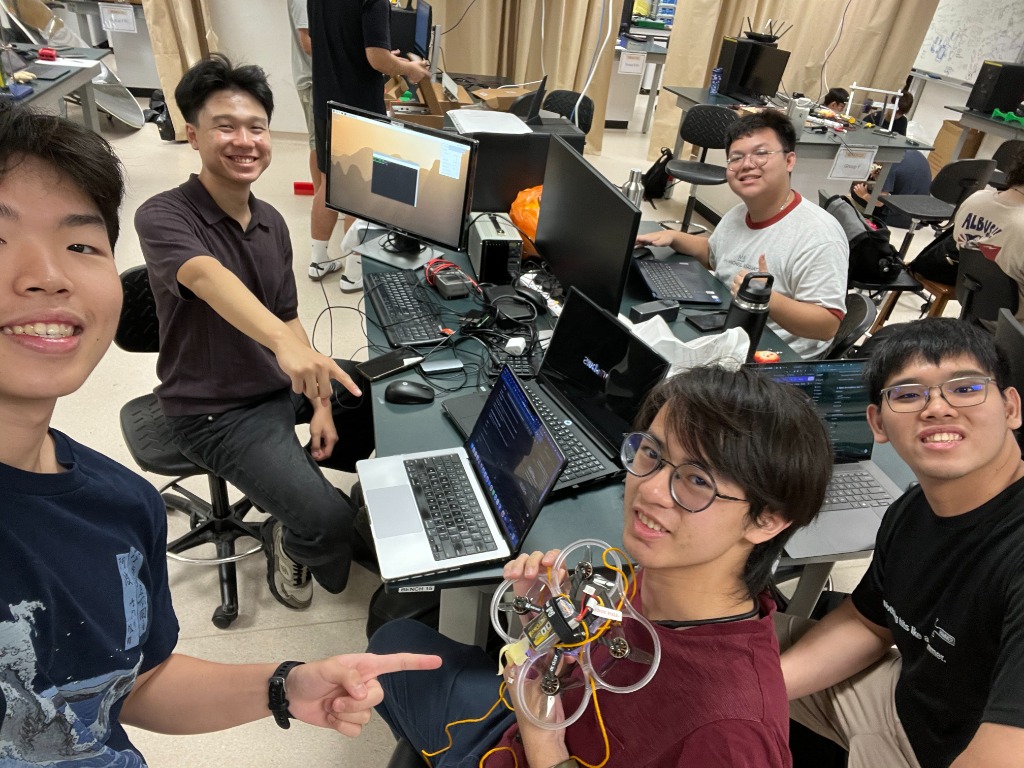
The Group 22
Makerspace Team.
An interdisciplinary group uniting biomedical science, robotics, mechanical design, and electronics to turn a wild concept into a working system.
Read the Complete PS5888 Documentation
Explore our full academic blog posts detailing weekly progress updates, CAD renders, wiring schematics, code snippets, and design specifications.
The Side Quests
Matter.
Stepping Outside My Field
As an undergraduate student studying Biomedical Sciences and BioBusiness on the NTU–Duke-NUS Pathways to Medicine, diving headfirst into drone flight controllers, optical flow calibration, 3D printing slicing parameters, and Linux networking felt entirely outside my traditional curriculum.
And that was precisely why it was one of the most rewarding experiences of my university journey.
In healthcare, science, or technology, the hardest problems never arrive neatly wrapped in the boundaries of a single discipline. DreamCatcher taught me how to break a complex, multidisciplinary problem into manageable modules: testing individual sensors first, understanding physical interfaces, debugging hardware-software latency, and learning from teammates whose strengths complement your own.
The prototype wasn't a commercial product, and parts of it took longer to debug than we planned. But the grit of rebuilding crashed frames, diagnosing why a camera stream dropped frames over Wi-Fi, and celebrating when the drone hovered reliably over the dock taught me something indelible: curiosity across disciplines makes you a better scientist, builder, and collaborator.